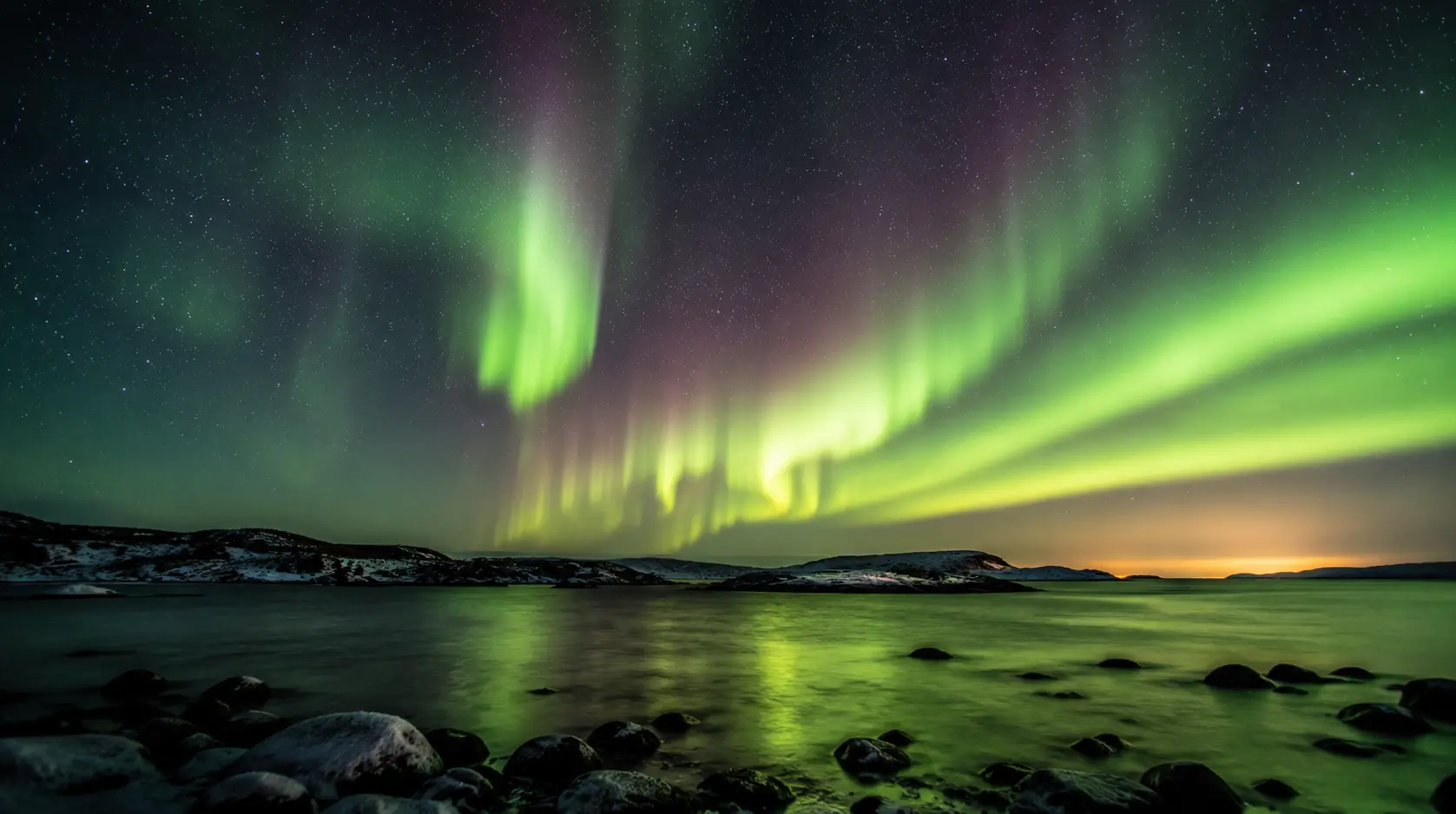
Darkness and magical sky
The northern lights are perhaps the image most associated with Northern Norway — and for good reason. Varanger lies around 70 degrees north, directly under the auroral oval, has some of the country's darkest nights and very little light pollution. From late September to late March, the chances are good, and you avoid competing with the tourist masses heading to Tromsø and Lofoten.
One of Varanger's great advantages is that you have many types of landscape to choose from under the same sky. Towards Tana and Pasvik the climate is drier and more continental, with often clearer nights, while the coast at Vardø, Vadsø and Hamningberg offers dramatic foregrounds with sea, lighthouses and fortress walls under the green light.
Polar night — the dark season in Varanger
In Vadsø the sun is below the horizon from 26 November to 16 January — a period of almost two months without direct sunlight. In Vardø, which lies furthest east, polar night is somewhat shorter. It is dark, it is quiet — and the sky can explode in green, pink and white.
Polar night is not just a time for northern lights. It is a mood, a calm that is difficult to describe for those who have not experienced it. The cities glow with advent stars and street lights, and inside cafes and restaurants it is warm and cozy. It is a season with strong identity for people in Varanger.
📅
26 Nov–16 Jan
Polar night in Vadsø
⭐
15 May–27 Jul
Midnight sun in Vardø
🌡️
−5 to −20 °C
Typical winter temperature
🌌
October–March
Best aurora season
What are northern lights — and why Varanger?
Northern lights occur when energy-charged particles from the sun collide with atoms in the atmosphere. The color depends on altitude and gas type: green is oxygen around 100 km up, red is oxygen higher up, blue and purple are nitrogen. Strong northern lights can dance and wave across the sky for hours.
Varanger lies in the auroral oval — an oval zone around Earth's magnetic pole where northern lights are most frequent. But what makes Varanger extra good is the combination of high latitude, long dark winter nights and very little light pollution. You can drive five minutes outside Vadsø and see a sky that is almost completely dark.
Where and how you see the northern lights
Three things determine whether you'll see northern lights: darkness, clear sky and activity. Darkness Varanger has plenty of in winter. Activity is controlled by the sun and cannot be planned, but can be followed via forecasts. What you can control most yourself is getting away from the city lights and finding a place with clear sky and free view towards the north.
Drive a few minutes out of the settlement, so street lights don't dazzle you, and find an open place — a beach, a fjord outlet, a height. Look towards the north and up towards the zenith; faint northern lights first look like a pale gray ribbon, and are often revealed more clearly through the camera than to the naked eye. If it's cloudy on the coast, a drive inland towards Tana or Pasvik may give clear skies. Give it time: let your eyes adjust to the darkness for 15–20 minutes, and be patient — a strong burst can come suddenly and last for hours.
📱
Follow the aurora forecast
Enjoy Varanger has its own aurora forecast that combines solar activity (KP index), cloud cover and darkness for places in the region — check it before you head out. As a rule of thumb, KP 3 or higher combined with clear skies gives good chances. Keep the heat on in the car, and be patient.
Photographing northern lights
Aurora photography is easier than you think. The most important thing is a camera with manual mode and a tripod. Set the aperture as open as possible (f/2.8 or lower), shutter speed between 5 and 15 seconds, and ISO between 800 and 3200. Focus is set manually to infinity — so that the stars are sharp.
For mobile photography: use night mode (Night Mode) and place your phone on something stable. Newer iPhone and Android models do a surprisingly good job with northern lights, especially in clear air.
How to increase your chances of seeing northern lights
- 🌙Book at least 3–5 nights. One night is not enough — weather, cloud cover and activity vary.
- 🌑Choose new moon periods. Dark skies give a much stronger aurora experience.
- 🚗Clouds are your enemy. Have access to a car so you can drive away from cloud cover.
- ❄️Dress well — really well. Standing still outside at −15 °C is cold even with good clothes.
- ⏰Northern lights are most active around midnight, but can appear from 8 pm to 2 am.
Ready for Varanger?
Browse experiences, accommodation and restaurants on the map.