A Russian spy with claws
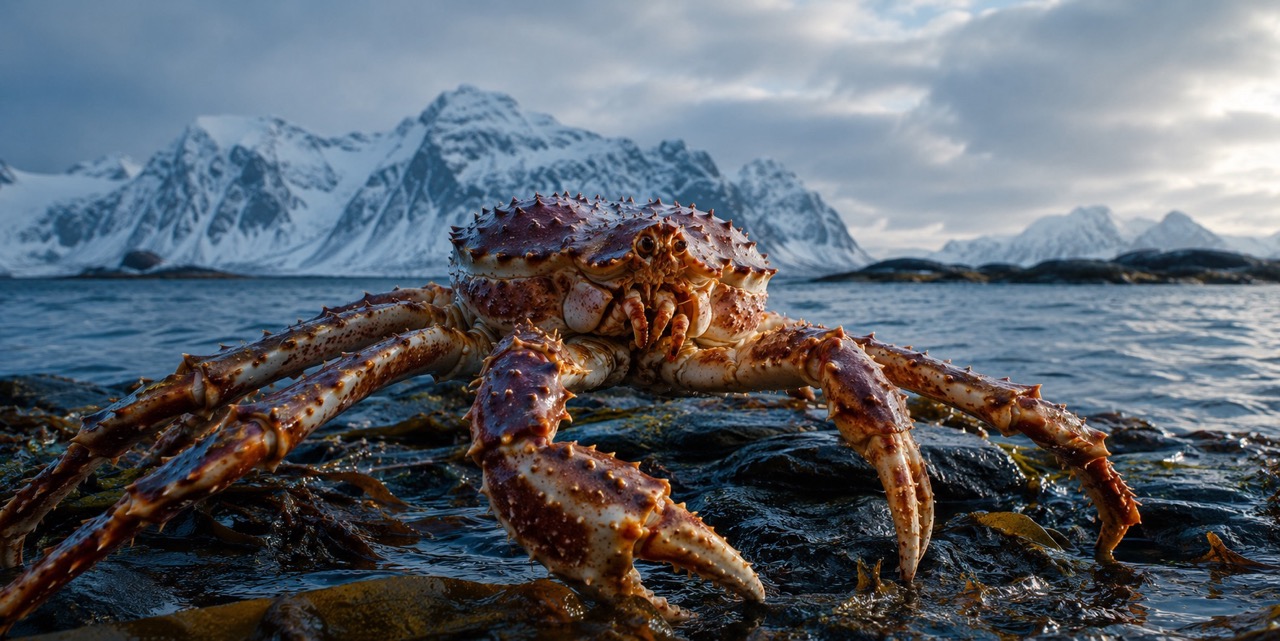
The king crab doesn't really belong in Norwegian waters. It is an intruder — a species that was deliberately planted in the Barents Sea and has since spread along the entire Norwegian coast. Today it is one of Varanger's most distinctive features, and every year thousands of guests come here to meet it face to claw.
From the Pacific to the Barents Sea
The story begins in 1961, when Russian researchers caught king crabs off Vladivostok in the Far East. The goal was to establish a new and lucrative fishery in the Barents Sea — one that Russian fishermen barely had. Crabs were transported alive to Murmansk and released into the sea.
The experiment succeeded beyond all expectations. The crab thrives in cold Arctic waters, and without natural enemies it spread unchecked. The first king crab was observed in Norwegian waters — in Varangerfjorden — in 1977. Since then the population has exploded.
Today the king crab is found from Kapp Kanin in the east to Loppa in Troms. It is classified as a foreign species in Norwegian nature and has, among other things, changed the bottom conditions over large seabed areas in Finnmark, since it eats almost everything that lives there.
⚖️
up to 15 kg
Weight of large individuals
📏
up to 1.8 m
Leg span claw to claw
📅
1961
Russians released the first ones
🇳🇴
1977
First observation in Norway
🎣
2002
Commercial fishing started in Norway
🌡️
0–3 °C
Thrives best in cold bottom water
🥚
up to ~300,000
Eggs a female can carry
🦀
26°E
Border between quota and open fishing
The king crab's cold logic
The king crab is a predator without equal on the Norwegian seabed. It eats mussels, sea urchins, starfish and other bottom-dwelling creatures — and in areas where it has stayed for a long time, it has virtually cleared the seabed of all life. This has major consequences for local fisheries, since among other things cod and haddock are dependent on the same seabed.
Norwegian authorities manage the king crab population with quotas and open zones. East of a line at the North Cape, professional fishermen have quotas. West of the line is open fishing for all — an attempt to limit further spread.
⚠️
Did you know that...
A full-grown king crab can live 20–25 years. The first traces of the species in Varangerfjorden were found by Norwegian fishermen who pulled up something they had never seen — and didn't know what to do with.
Curse and goldmine at the same time
Few species divide people like the king crab. For nature it is an intruder that clears the seabed of mussels, starfish and other life — and researchers are concerned about the long-term effects on the Barents Sea ecosystem. For the coastal communities in East Finnmark, it has simultaneously become «red gold»: a highly paid export commodity that has breathed new life into small fishing villages like Bugøynes and Båtsfjord.
Norway therefore manages the crab with a deliberate two-tier system. East of 26°E (approximately at the North Cape) there is a regulated quota fishery where local fishermen have the right to a specific number of crabs per year — an arrangement that provides income to the villages while keeping the population in check. West of the line is open fishing for all, without quotas, precisely to slow the species spreading further south along the Norwegian coast.
The result is that the king crab is both fought and cultivated — depending on which side of the map you stand on. Anyone who joins a safari in Varanger participates in practice in local management: the crabs that are pulled up are part of the regulated catch.
When can you experience the king crab?
King crab safaris run year-round, and there is really no «wrong» season — but the experience changes character with the seasons. In summer, tours go out in RIBs or open boats on calm fjords under the midnight sun, often combined with birdwatching and fjord scenery. It is the easiest and most accessible way to meet the crab.
In winter it becomes dramatic: holes are drilled in ice-covered fjords, the pots are lowered into the darkness, and the catch happens while the cold bites and the northern lights may stand over you. Winter safari is the most sought-after — and the one that requires the best clothes and earliest booking.
The crab itself is equally good year-round, but many believe the meat is at its fullest in the cold months. No matter when you go: you eat the catch fresh, often the same day it was pulled up.
How it tastes — and how to eat it
It's the claws and the long legs that are the delicacies. The meat is white, firm and naturally sweet, with a cleaner and milder flavor than edible crab. It needs almost nothing: light boiling or steaming, a bit of butter, good bread and perhaps a squeeze of lemon.
On a safari the crab is usually served straight from the pot on board or back at the lodge — you crack the shells with your hands and dig out the meat yourself. It's messy, it takes time, and that's exactly how it should be. At restaurants in Varanger you'll also find it served more elegantly, but the principle is the same: the raw ingredient is so good that it should ideally be left as much alone as possible.
King crab safari — catch, cooking and taste
A king crab safari is one of the most popular experiences in Varanger. You head out onto the fjord with an experienced skipper — usually early morning or evening — and pull up the crab pots that were set the night before.
It's not uncommon to pull up crabs so large they barely fit in the bucket. After the catch, food is made: the crab is boiled or grilled during the tour, and you eat it fresh on board or back at the lodge. With butter-fried bread and a cup of hot broth, this is a taste experience few forget.
Safaris run year-round, but winter fishing from ice-covered fjords is a unique experience. You drill a hole in the ice, lower the pot and wait — while the cold bites and the northern lights dance across the sky above you.
Tips for king crab safari
- 📅Book well in advance — especially the winter season is popular and fills up quickly.
- 🧤Dress warmly. Out on the fjord it is colder than you think, even if it is summer.
- 📸Bring a camera — the crab is spectacular up close and makes great pictures.
- 🦀Eat with your hands. It is the only right way to eat king crab.
Businesses for this guide
Local operators that fit this theme.

Ready for Varanger?
Browse experiences, accommodation and restaurants on the map.