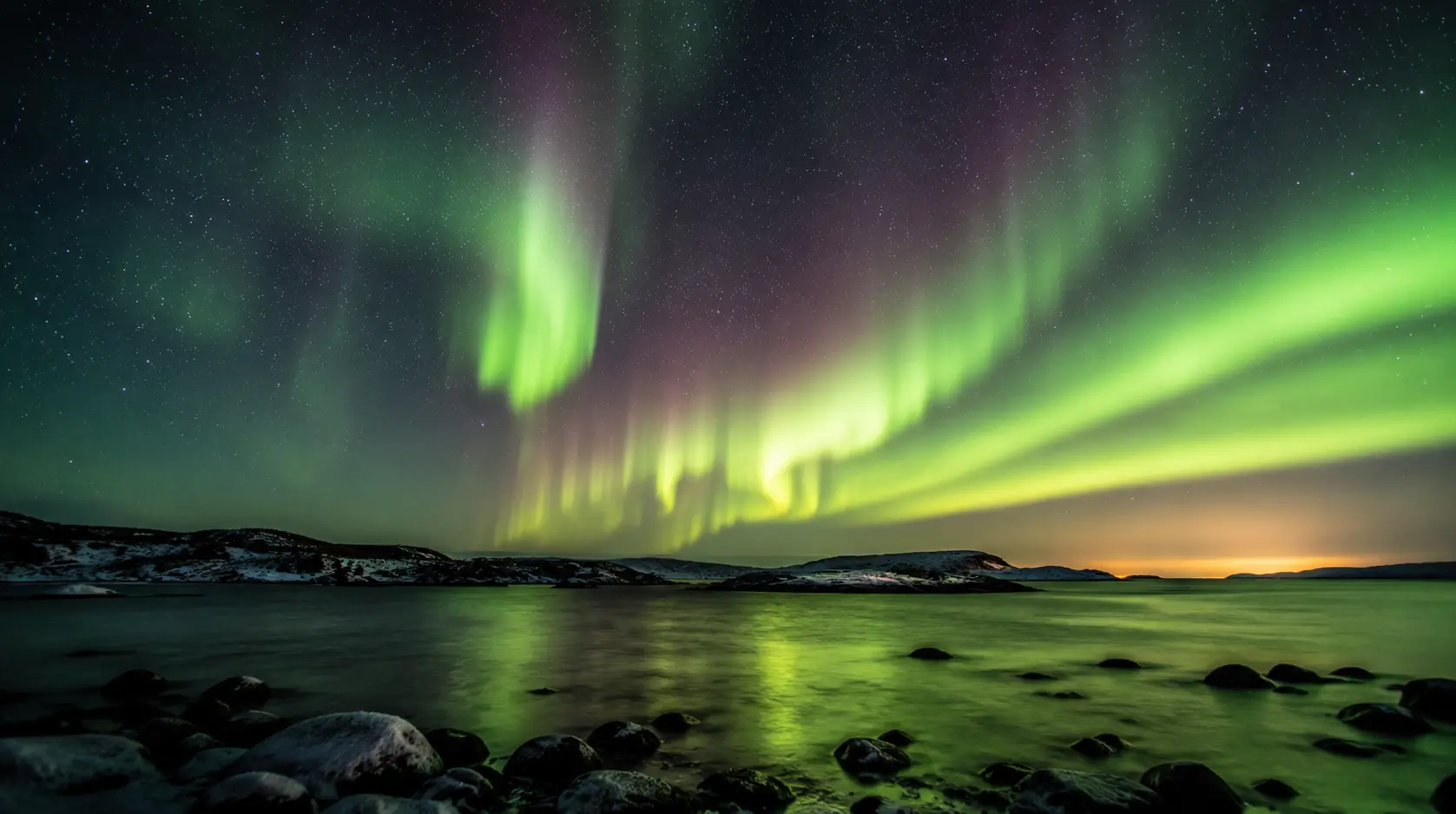
Polar night and magical skies
The northern lights are perhaps the image people associate most with Northern Norway — and for good reason. Varanger lies deep in the aurora belt, has some of the country's darkest nights and almost zero light pollution. From November to March the chances of seeing the aurora are excellent, and you avoid the tourist crowds that descend on Tromsø and Lofoten.
Polar night — the dark season in Varanger
In Vadsø the sun stays below the horizon from 26 November to 16 January — a period of nearly two months without direct sunlight. In Vardø, which lies furthest east, the polar night is somewhat shorter. It is dark, it is quiet — and the sky can explode in green, pink and white.
The polar night is not just a time for northern lights. It is a mood, a stillness that is difficult to describe for those who have not experienced it. The towns glow with advent stars and streetlights, and inside cafés and restaurants it is warm and welcoming. It is a season with a strong identity for people in Varanger.
📅
26 Nov–16 Jan
Polar night in Vadsø
⭐
15 May–27 Jul
Midnight sun in Vardø
🌡️
−5 to −20 °C
Typical winter temperature
🌌
October–March
Best aurora season
What are northern lights — and why Varanger?
Northern lights occur when energetically charged particles from the sun collide with atoms in the atmosphere. The colour depends on altitude and gas type: green is oxygen around 100 km up, red is oxygen higher still, blue and purple are nitrogen. Strong auroras can dance and ripple across the sky for hours.
Varanger lies in the aurora belt — an oval zone around Earth's magnetic pole where the northern lights are most frequent. But what makes Varanger extra good is the combination of open skies over the Barents Sea and almost no light pollution. Drive five minutes outside Vadsø and you have a sky that is almost completely dark.
📱
Follow the forecast
The "My Aurora Forecast" app and the website aurora-norway.no provide real-time alerts for aurora activity (KP index) and cloud cover. Aim for KP 3 or higher for a good display. Keep the heater running in the car and be patient — the aurora can appear suddenly.
Photographing the northern lights
Aurora photography is simpler than you think. The key things are a camera with manual mode and a tripod. Set the aperture as wide as possible (f/2.8 or lower), shutter speed between 5 and 15 seconds, and ISO between 800 and 3200. Focus manually on a distant light or bright star — so the stars are sharp.
For phone photography: use Night Mode and rest the phone on something stable. Newer iPhone and Android models do a surprisingly good job with the aurora, especially in clear air.
How to maximise your chances
- 🌙Book at least 3–5 nights. One night doesn't give you enough chances — weather, cloud cover and activity all vary.
- 🌑Choose new moon periods. A dark sky gives a far stronger aurora experience.
- 🚗Clouds are your enemy. Have access to a car so you can drive away from the cloud cover.
- ❄️Dress properly — really properly. Standing still outside at −15 °C is cold even in good clothes.
- ⏰The aurora is most active around midnight but can appear from 8 pm to 2 am.
Klar for Varanger?
Se opplevelser, overnatting og restauranter på kartet.