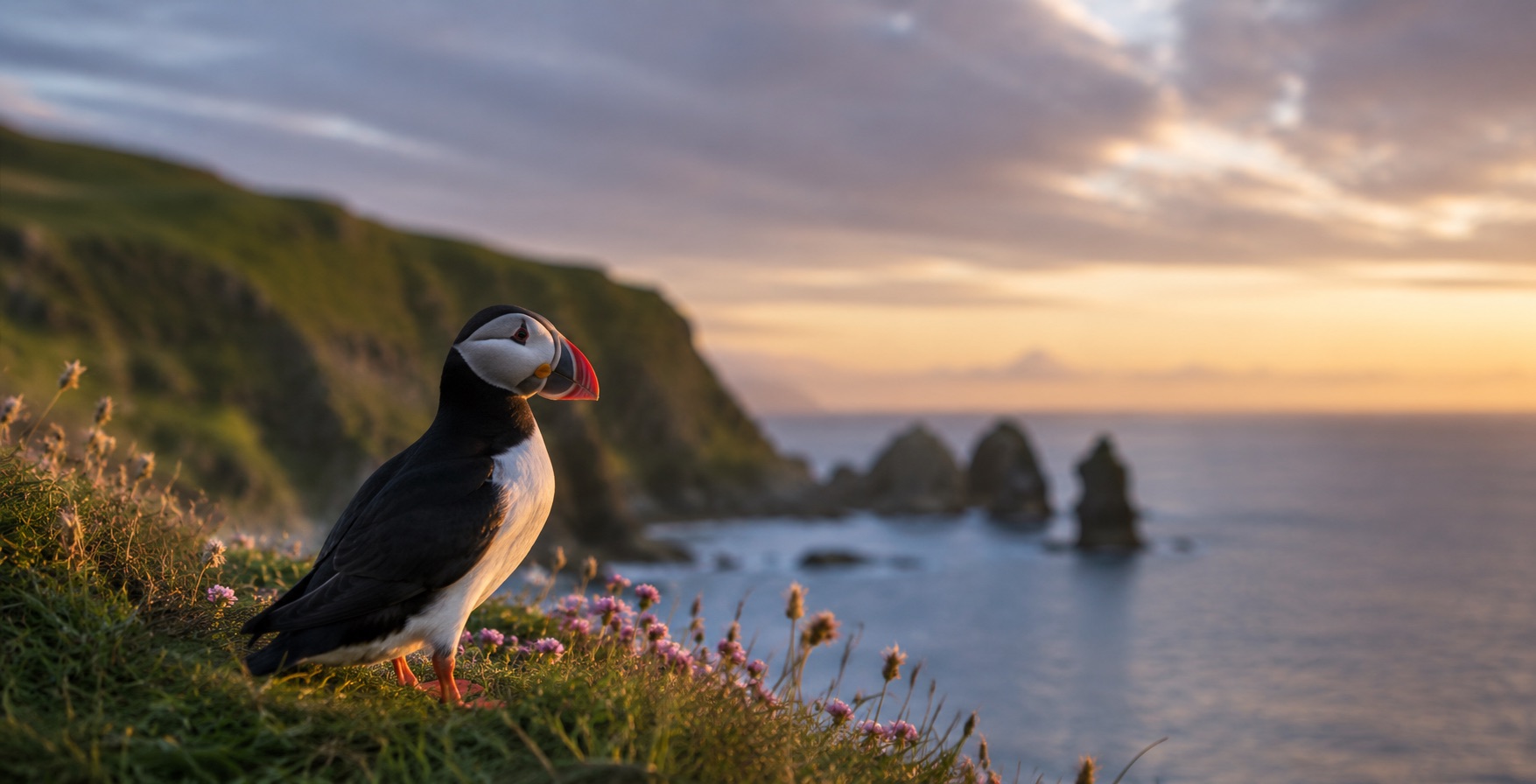
One of the world's best places for Arctic birds
The northeastern corner of Norway is among the world's very best birdwatching destinations — and perhaps the easiest place in Europe, if not in the world, to see long-tailed ducks up close. Varanger features regularly on lists of the world's premier bird destinations, and for many ornithologists a trip here is a lifelong dream. Arctic sea, coast, birch forest, river deltas and bare tundra meet in a small area, and the result is bird life that few other places can match.
What makes it particularly special is how easily everything is accessible. Rare Arctic species that otherwise require long expeditions to Siberia or Svalbard can be seen here from a quay or road. Over 200 bird species have been recorded in the region.
Why Varanger is world-class
Varanger lies at the entrance to the Barents Sea, where the warm Atlantic current meets cold, nutrient-rich Arctic water. This creates a very rich marine environment that attracts enormous quantities of seabirds. At the same time, birch forest, wetlands, river deltas and bare fells are tightly packed together, allowing an extraordinary range of species to find food and breeding grounds within short distances.
The peninsula is also a junction point for birds migrating between Siberia, the Arctic and Western Europe. Rare species from the east appear regularly, and each season has its specialties — from overwintering Arctic ducks in winter to breeding seabirds and waders in summer.
🐦
200+
Recorded bird species in the region
🦆
~5,000
Long-tailed ducks overwintering in Varanger
🪺
80,000+
Seabirds on Hornøya in summer
🐧
7,500+
Puffin pairs breeding on Hornøya
Winter stars — long-tailed ducks and king eiders
In winter, Varanger transforms into an Arctic aquarium of sea ducks. Around 5,000 long-tailed ducks overwinter here — a small, beautiful duck species that breeds on the Siberian tundra, but migrates to the ice-free Barents Sea when Siberia freezes over. Varanger is the place in Europe where you can most easily get close to them, often right by the quay in the harbours.
The other winter jewel is the king eider. The male, with its orange and light blue head shield, is considered one of the world's most beautiful seabirds, and in winter and spring they gather in flocks of over a thousand birds in the harbours around Vadsø, Vardø and Båtsfjord. In the same waters you see common eiders, white-winged scoters and — if you're lucky — the majestic yellow-billed diver. The best time for winter birds is February to April, when the light returns and the sea ducks are most numerous.
Hornøya — Norway's easternmost bird cliff
Just outside Vardø lies Hornøya, a small nature reserve of only 0.4 square kilometres that in summer houses over 80,000 seabirds — and Norway's easternmost point. More than 7,500 puffin pairs breed on top of the cliff, together with guillemots, Brünnich's guillemots, auks, kittiwakes, black guillemots and shags in dense colonies on the steep ledges. The sound, smell and sight of tens of thousands of birds up close is one of the strongest natural experiences Norway has to offer.
You can reach Hornøya by boat from Vardø during the breeding season, approximately from March to August. On the island you can walk up to the old lighthouse along a simple path, while the birds fly past close by. Stick to the path, do not disturb the nests, and remember that the top can be slippery and exposed to wind.
Tundra and wetland birds
Inland from the coast, the tundra and wetlands open up, with a completely different birdlife. In spring, large flocks of waders rest on the mudflats at Nesseby and Varangerbotn on their way to breeding grounds further north — grey phalaropes, dotterels, Temminck's stints and ruff are among the species. On the plateaus, red-throated divers and black-throated divers breed by the tarns, and in good vole years the snowy owl appears along with merlin and white-tailed eagle.
Of raptors, the white-tailed eagle is almost impossible to avoid along the fjord — Europe's largest bird of prey with a wingspan of up to 2.4 metres. With luck you will also see the rare peregrine falcon, merlin and ptarmigan. It is this mix of sea, coast and tundra in one small area that means a good day in Varanger can give species most European birdwatchers only dream about.
🏛️
Architect-designed bird hides
The Norwegian architecture firm Biotope — the world's first architecture firm dedicated to birds — has designed a series of bird hides and viewing points along Varangerfjorden. They are adapted to the location and the species you see there, and are attractions in themselves. You can find bird hides among others in Vadsø, on Ekkerøya, in Vestre Jakobselv, near Kiberg, Domen, Steilneset and Hamningberg.
The best places to watch
The entire coast along National Tourist Route Varanger (from Varangerbotn to Hamningberg) is one continuous birdwatching route with stop after stop. Vadsø harbour is known for king eiders and long-tailed ducks in winter. Ekkerøya has a small bird cliff with kittiwakes and is easy to walk around. Nesseby and Varangerbotn at the inner end of the fjord are best for waders on spring migration. Kiberg, Vardø and Hamningberg lie at the outer edge towards the sea, with seabirds and chances of rarities from the east.
Komagdalen in the national park has a short birdwatching trail with information boards, and Hornøya is the major summer destination. With a rental car and a few days you can cover most of it — distances are short, but there is much to stop for.
Best time to visit
Varanger is worth a visit almost year-round, but it depends on what you want to see. Winter and early spring (February–April) is the time for Arctic sea ducks: long-tailed ducks, king eiders, common eiders and yellow-billed divers gather in the harbours, and the light returns. Late spring (May–June) brings wader migration and the first breeding birds. Summer (June–July) is peak season for bird cliffs and offers the midnight sun, so you can watch all day and night.
Late summer and autumn (August–October) are quieter, but can offer exciting rarities in migration. The only difficult period is the dark season around Christmas (approximately mid-November to the end of January), when daylight is too short for effective birdwatching — but in return the northern lights are at their very best.
Come well prepared
- 🔭Bring binoculars and preferably a telescope on a tripod. Many sea ducks and divers lie far out on the fjord.
- 🧥Dress very warmly in winter — you stand still in Arctic cold and wind by the seashore. Windproof outer layer, gloves and hat are a must.
- 🚗A rental car gives the most freedom. Drive National Tourist Route Varanger with many stops; in winter, winter tyres are mandatory and roads can be slippery.
- ⛴️If you want to go to Hornøya, arrange boat transport from Vardø in advance during the breeding season (approximately March–August).
- 👢Waterproof shoes or wellington boots are useful on the mudflats at the inner end of the fjord.
- 🗓️Check recent observations on Artsobservasjoner.no and BirdLife Norway before you go — and consider hiring a local bird guide to find the specialties quickly.
- 🪺Be considerate: keep distance from nests and colonies, do not scare up birds unnecessarily, and follow paths on Hornøya.
Ready for Varanger?
Browse experiences, accommodation and restaurants on the map.