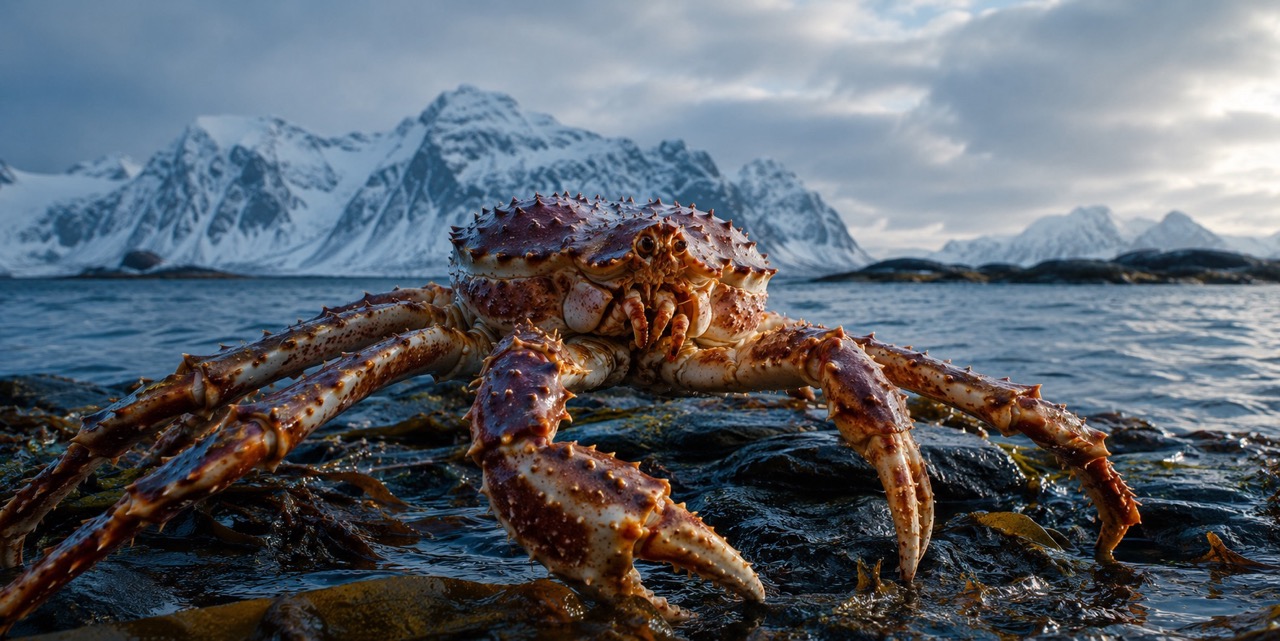
A Russian spy with claws
The king crab has no natural place in Norwegian waters. It is an invader — a species planted in the Barents Sea on purpose, and which has since spread along the entire Norwegian coast. Today it is one of the most iconic things about Varanger, and every year thousands of visitors come here to meet it face to claw.
From the Pacific to the Barents Sea
The story begins in 1961, when Soviet researchers caught king crabs off Vladivostok in the Russian Far East. The goal was to establish a new and profitable fishery in the Barents Sea — one the Russian fishermen barely had. Living crabs were transported to Murmansk and released into the sea.
The experiment worked beyond all expectations. The crab thrives in cold Arctic water, and without natural predators it spread unchecked. The first king crab was observed in Norwegian waters — in the Varangerfjord — in 1977. Since then the population has exploded.
Today king crabs are found from Cape Kanin in the east to Loppa in Troms. It is classified as an alien species in Norwegian nature and has transformed the seabed over vast areas of Finnmark, as it eats almost everything living there.
⚖️
up to 15 kg
Weight of large individuals
📏
up to 1.8 m
Leg span claw to claw
📅
1961
Russians released the first crabs
🇳🇴
1977
First observation in Norway
The cold logic of the king crab
The king crab is a predator without equal on the Norwegian seabed. It eats mussels, sea urchins, echinoderms and other bottom-dwelling creatures — and in the areas where it has been established for a long time, it has almost swept the seabed clean of all life. This has major consequences for local fisheries, since cod and haddock depend on the same seabed.
Norwegian authorities manage the king crab population with quotas and open zones. East of a line near North Cape, commercial fishers have quotas. West of the line there is open fishing for everyone — an attempt to limit further spread.
⚠️
Did you know...
A fully grown king crab can live for 20–25 years. The first traces of the species in the Varangerfjord were found by Norwegian fishers who hauled up something they had never seen — and had no idea what to do with.
King crab safari — catch, cook and taste
A king crab safari is one of the most popular experiences in Varanger. You head out on the fjord with an experienced skipper — often early morning or evening — and pull up the crab pots set the night before.
It is not unusual to pull up crabs so large they barely fit in the bucket. After the catch the food is prepared: the crab is boiled or grilled during the trip and you eat it fresh on board or back at the lodge. With butter-fried bread and a cup of warm broth this is a taste experience few ever forget.
Safaris run year round, but winter fishing from frozen fjords is a uniquely special experience. You drill a hole in the ice, lower the trap and wait — while the cold bites and the northern lights dance over the sky above you.
Tips for your king crab safari
- 📅Book well in advance — the winter season especially fills up fast.
- 🧤Dress warmly. Out on the fjord it is colder than you expect, even in summer.
- 📸Bring a camera — the crab is spectacular up close and makes for great photos.
- 🦀Eat with your hands. It is the only proper way to eat king crab.
Företag för denna guide
Lokala aktörer som passar till temat.

Redo för Varanger?
Se upplevelser, boende och restauranger på kartan.