Norway's easternmost town — and one of its strangest
Vardø is a place where history sits in the walls and in the very ground. Here 91 women and men were burned as witches in the 17th century — Europe's second highest number after Scotland. Here Russian merchants conducted Pomor trade for 200 years. Here the midnight sun reaches you three days before anywhere else in Norway. And here the architects Peter Zumthor and Louise Bourgeois raised one of the country's most celebrated memorials.
Vardøhus Fortress — since the 1300s
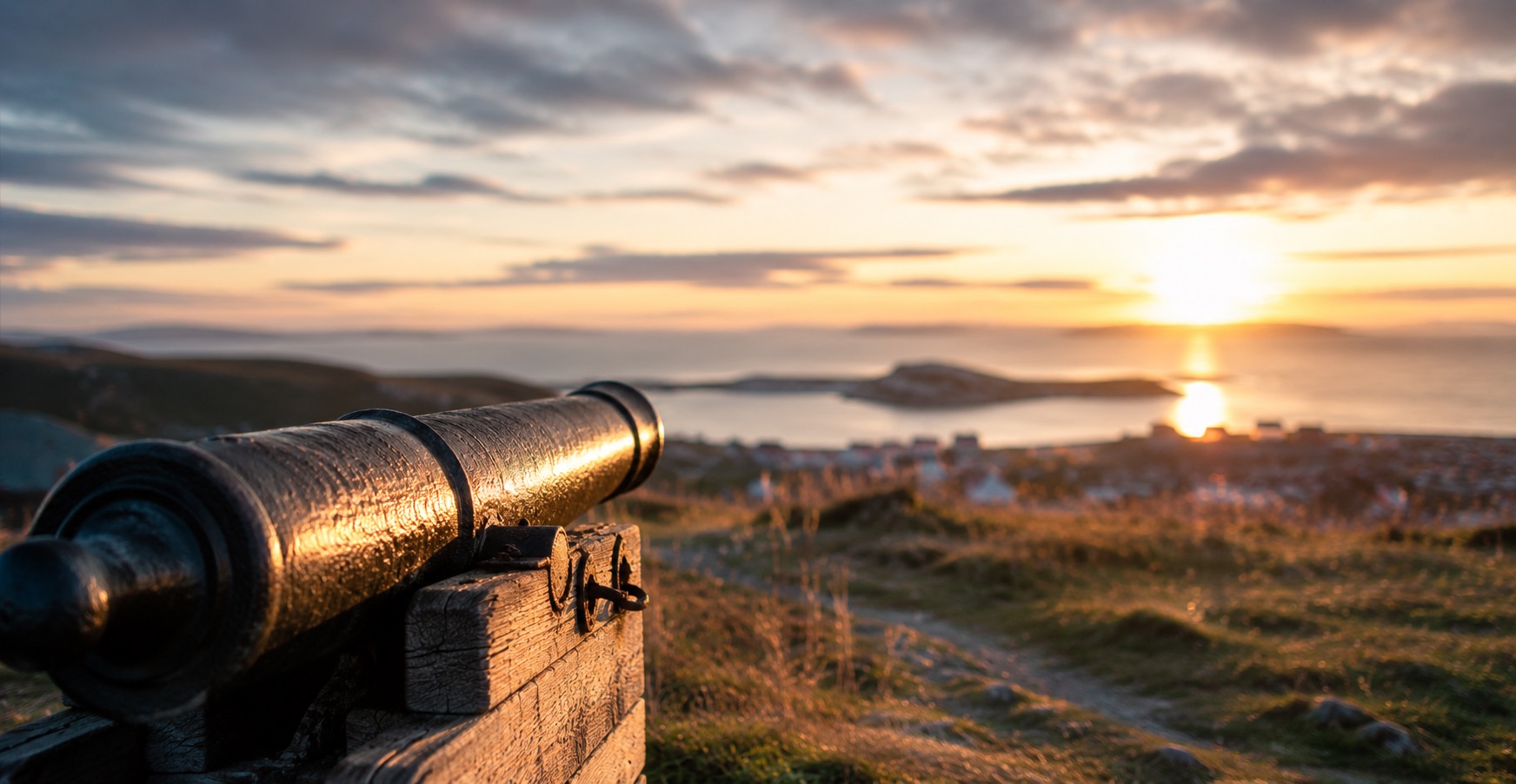
Vardøhus Fortress is the oldest fortification in Northern Norway. The first castle was built in 1306 — by order of King Håkon V — to mark Norwegian sovereignty in the far east of the realm. The fortress we see today was erected in 1734 and is in excellent condition.
The fortress is one of Norway's smallest but one of its best preserved. It is open to visitors in summer, and from the bastions you have a fine view over the Varangerfjord, the Barents Sea and Hornøya. A salute cannon is fired on national day.
Steilneset Memorial — for those burned as witches
Between 1601 and 1692, 91 people in Finnmark were accused of witchcraft and burned at the stake — over half of them in Vardø and Vadsø. It is the highest number per capita in Scandinavia, and the second highest in Europe. The victims were mostly women, but also men — fishermen, farmers, servant girls.
In 2011 then-Prime Minister Jens Stoltenberg and Queen Sonja inaugurated a memorial of international standing: Steilneset. The architect is Swiss Peter Zumthor — one of the world's most celebrated architects and a Pritzker Prize laureate. The artwork inside was created by the French-American artist Louise Bourgeois, who died the same year.
The memorial consists of two parts: a long timber structure with 91 burning lamps (one for each victim), and a glass pavilion containing a burning chair and mirrors. It is harrowing and beautiful at the same time, and it draws visitors from around the world.
🕯️
Steilneset
One of Norway's most important contemporary artworks. Open in summer. Free admission. Allow at least an hour — it is not a place you rush through.
The Pomor era — 200 years of Russian trade
From the early 18th century until the Russian Revolution in 1917, Russian merchants — Pomors — conducted intensive trade along the Norwegian coast. They came in their characteristic lodjas (wooden boats) from the White Sea coast, loaded with rye flour, salt and other goods, and returned home with fish.
Vardø was the centre of this trade and was granted town status by the king in 1789 partly because of the Pomor traffic. At its peak hundreds of Russians overwintered in Vardø each summer. A unique "Pomor pidgin" — a mixed language of Norwegian and Russian — developed and was used in trade.
The Pomor trade vanished abruptly in 1917. Today the Pomor Museum in Vardø tells the story through artefacts, photographs and documents from this remarkable period.
Hornøya — the bird cliff at the far end
Just over a kilometre off Vardø lies Hornøya — Norway's easternmost nature reserve and one of the most important seabird nesting sites in the country. The island hosts puffins, Brünnich's guillemots, common guillemots, little auks, black-legged kittiwakes and European shags in enormous numbers. In summer it is almost impossible to hear your own thoughts.
A boat to Hornøya runs daily from Vardø harbour in summer. The trip takes approximately 15 minutes and you can walk independently on the marked paths. The birds are so trusting they almost land on your head.
📅
1306
First Vardøhus Fortress built
🕯️
91
Victims of the witch trials
🚢
1700–1917
The Pomor era — Russian trade
☀️
15 May
First midnight sun day in Norway
Redo för Varanger?
Se upplevelser, boende och restauranger på kartan.